Posts

Soil NCERT Science Class 7 Chapter 9 Summary

Image
Soil Upper layer of earth crust, is called soil.  The mixture of rock particles and humus is called the soil.  Humus The rotting dead matter in the soil is called humus.  Weathering Formation of soil by break down of rocks by the action of winds, water and climate, is called weathering.  Nature of soil depends on The parent rock  Vegetation grows on it.  Wind, Climate, rainfall, temperature, light and humidity.  Soil profile  A vertical section through different layers of the soil is called soil profile.  Horizon Each layer of soil differing in texture, colour, depth, and chemical composition, is called horizon.  A-Horizon  It is dark in colour.  It is rich in humus.  Soil is fertile.  This layer is soft and porous.  This layer can retain more water.  It is also called top soil.  B-Horizon  This layer has lesser amount of humus.  This layer has more amount of minerals.  This l...

Winds, Storms and Cyclones NCERT Science Class 7 Chapter 8 Summary Note

Image
Wind Moving air is called wind.  Air exerts pressure.  High speed winds are accompanied by reduced air pressure.  Air moves from the region where the air pressure is high to the region where the pressure is low.  Why Smoke(warm air) goes up?  Generation of wind currents -Uneven heating between the equator and the pole  -Uneven heating of land and water   Monsoon winds carry water and it rains. 

Weather, Climate and Adaptation of Animals to Climate NCERT Science Class 7 Chapter 7 Summary

Image
Weather Temperature, rainfall, humidity, wind speed etc., of a place at a time is weather of that place.  Elements of weather Temperature Humidity Rainfall Wind speed etc.  The weather of a place changes day after day and week after week.  Maximum-Minimum thermometer Thermometer used to measure temperature of atmosphere, is called maximum-minimum thermometer.  The maximum temperature of the day - in afternoon.  The minimum temperature of the day- in early morning.  All changes in the weather are caused by the sun.  Climate The average weather pattern taken over a long time is called climate of the place.  Types of climate Hot and dry  Hot and wet Cold and dry  Cold and wet Adaptation Change in organism to cope changing environment, is called adaptation.  Polar regions These regions are covered with snow.  Climate- Very cold.  Day- 6months, Night-6months  Temperature- as low as -37°C. Animals present- Polar bear, ...

Physical and Chemical Changes NCERT science class 8 Chapter 6 Summary Note

Physical properties Shape, size, colour and state of a substance are called its physical properties. Chemical properties Chemical composition of a substance are called its chemical properties. Kinds of changes -  (i) Physical changes  (ii) Chemical changes            OR  (i) Reversible changes (ii) Irreversible changes Physical changes  Changes in physical properties of a substance, is called physical changes.  Such change is reversible change.  No new substance is formed in such change. Example- Cutting of paper Chemical changes  Changes in chemical properties of a substance, is called chemical changes.  Such change is irreversible change.  New substance is formed in such change. Example- Burning of paper                   Burning of magnesium Few common Examples of Chemical changes   (i) Burning of magnesium ribbon    Magnesium + Oxygen -----> ...

Acids, Bases and Salts NCERT Science Class 8 Summary Note

Acids The chemicals causing sourness of substance, is called acids .  These are not soapy to touch.  These turn blue litmus into red.  Example- Acetic acid(chemical in vinegar)  Bases The chemicals causing bitterness of substance, is called bases .  These are soapy to touch.  These turn red litmus into blue.  Example- baking soda, calcium hydroxide etc.  Indicator The substance used to test whether a substance is acidic or basic, are called indicator.  Example- Turmeric, litmus, china rose petals, phenolphthalein etc.  Litmus:A natural dye It is a natural indicator.  It is extracted from lichen.  When added to acid, it turns red.  When added to base, it turns blue.  Available in- Solution form, Paper strips Neutral solution The solution which donot change the colour of either red or blue litmus, is known as neutral solution.  Example- Sugar solution, water etc.  China rose as indicator China rose indicator t...

Elements Online Test NCERT Science

Topic of online quiz- Elements and their symbols No. of questions-10 Types of questions-MCQ Loading…

Heat NCERT Science Class 7 Chapter 4 Summary Note

Image
Heat Energy that increases hotness of an object.  Temperature A reliable measure of the hotness of an object, is its temperature .  Thermometer A device used to measure temperature, is called thermometer .  Types of thermometer (i) Clinical thermometer (ii) Laboratory thermometer (iii) Maximum-minimum thermometer Clinical thermometer -The thermometer used to measure temperature of body, is called clinical thermometer.  -It consists of- glass tube,                           Bulb                           Mercury thread                           Kink -Range- 35°C to 42°C. -It has kink.  Clinical thermometer Laboratory thermometer -The thermometer used to measure temperature of an object, is c...

Stars and the Solar System NCERT Science Class 8 Chapter 17 Summary Note

Stars and Solar System Celestial objects The stars, the planets, the moons and many other objects in the sky are called celestial objects.  Full Moon Day  The day on which the whole disc of the moon is visible is known as full moon day.  New Moon Day On the fifteenth day after full moon day, the moon is not visible. This day is known as new moon day.  Crescent Moon  The moon whose only a small portion appears in the sky, is called crescent moon.  Phases of Moon  The various shapes of the bright part of the moon as seen during a month are called phases of moon.  The moon doesn't produce its own light.  We see the moon because, the sunlight falling on it gets reflected towards us.  The moon rotates on its axis.  The moon revolve around the Earth.  The moon has no atmosphere, no water,  Star The sun is also a star.  Sun appears larger than other stars. Because- -Stars are millions of times farther away than the sun....

Unit Conversion Calculator

Light NCERT Science Class 8 Summary Note

Image
What Makes Things Visible   When light from an object enters our eyes, then we see the object.  The light may have been emitted or reflected by the object.  Mirror   Highly polished surface is called mirror.  Reflection Bending back of light ray after falling on a surface, is called reflection.  Incident ray The light ray which strikes any surface, is called incident ray.  Reflected ray  The ray that comes back from the surface after reflection, is called as reflected ray.  Normal Line perpendicular to surface at point of incidence of light ray, is called normal.  Angle of incidence The angle between normal and incident ray, is called angle of incidence.  Angle of reflection The angle between normal and reflected ray, is called angle of reflection.  Laws of reflection (i) The incident ray, the normal at the point of incidence and the reflected ray, all lie in the same plane.  (ii) The angle of incidence is always equal to ...

Some Natural Phenomena NCERT Science Class VIII Chapter 15 Summary Note

When we take off clothes in dark, we see a spark and crackling sound. Because - Our body gets rubbed with clothes.  - This produces charges.  - When charges meet, they cause spark and crackling sound.  Charged object Object having electric charge.  Example- Rubbed balloon Electric charges are generated by rubbing.  Types of charges-  (a) Positive charge  (b) Negative charge  Interaction between charges -Like charges repel each other.  -Unlike charges attract each other.  It is a convention to call the charge acquired by a glass rod when it is rubbed with silk as positive.  The another kind of charge is said to be negative.  Static charge  Charge that do not move.  Electric current Movement of charges , is electric current.  Electroscope  A device that test whether an object is charged or not, is called electroscope. 

Chemical Effects of Electric Current NCERT Summary Class VIII Science Chapter 14

Image
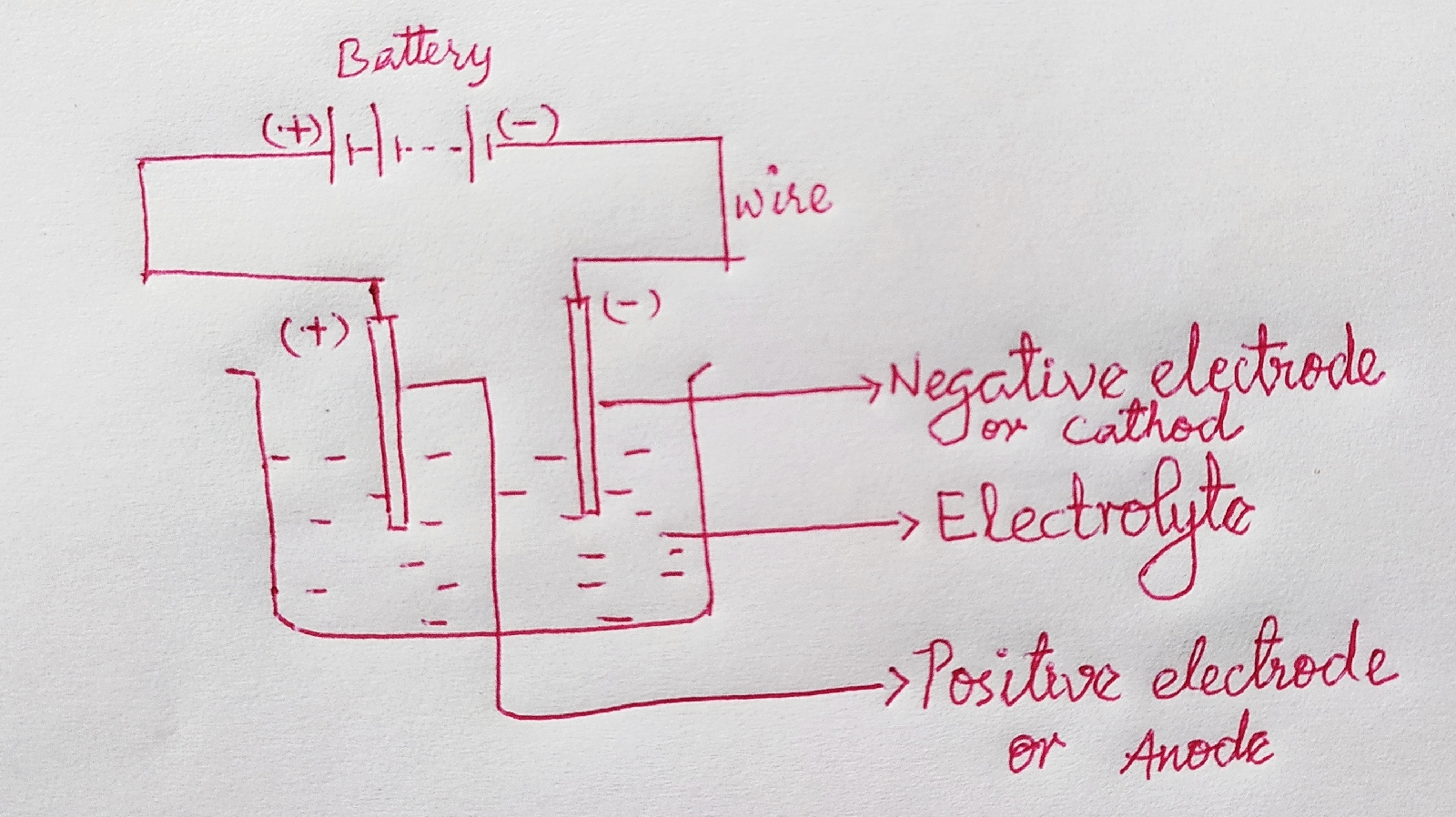
Good Conductor The substance through which electricity can pass is called good conductor.  Examples - Copper, Aluminum Poor conductor The substance through which electricity can not pass is called poor conductor. Examples - Rubber, plastic etc.  Tester A device that test conductance of a substance, is called tester.  Solutions of acids, bases and salts are generally good conductor.  Chemical effects of Current Chemical reactions (effects) caused when electricity passes through a conducting liquid, is chemical effects of current.  How to recognize chemical reaction - Release of gas - Change of colour of solution - Release of heat - Formation of new substance In battery No. of terminals- 2 (positive and negative)  Positive terminal is also called Anode .  Negative terminal is also called cathode .  Solution  is called electrolyte .  Passing current through a solution ...

Friction NCERT Science Class 8 Chapter 12 Summary Note

Friction The force that opposes the relative motion between two surfaces in contact, is called friction.  Factors affecting friction Weight of object  Nature of surfaces in contact More the weight of object, more the friction.  More smooth surface experience less friction.  Importance of friction Friction helps in stopping object Friction helps to write, walk,  Friction helps in all activities Friction produces heat.  Harm cause by Friction Sole of shoes wear out.  Machine parts get wear out.  Friction can be increased by making surfaces rough. ( More rough means more interlocking between surfaces which means more friction )  Friction can be decreased by applying lubricant on surfaces.  Friction can be decresed by changing shape of object.  Rolling friction The force that oppose motion of rolling object, is rolling friction.  Sliding friction The force that oppose moti...

Force and Pressure NCERT Science Class 8 Summary Note

Force   The push or pull of an object, is called force.  Forces are due to interaction between objects.  Force applied on an object in the same direction add to each other.  Force applied on an object in opposite directions substract each other.  The strength of force is measured by its magnitude.  A force can change the state of motion of an object.  Change in state of motion jeans Rest to motion Motion to rest  Increase in speed  Decrease in speed Force on an object may change its shape.  Types of forces   Contact force   The force that can be applied only by touching object,is called contact force.  Non-Contact force   The force that can be applied without touching object,is called contact force.  Muscular force   The force resulting due to action of muscles is called muscular force.  Friction The force that oppose motion of an object.  Magnetic force The force exerted by a magnetic material is ...

Reaching the Age of Adolescene

Reaching the Age of Adolescene  Adolescene The period of life, when the body undergoes changes , leading to reproductive maturity, is called adolescene.  Period - age of 11 to age of 19. Also called " teen age ". Because this period covers the teen ages i.e, 13 to 19  Adolescene may begin earlier in girls than boys.  Puberty Period during adolescene, when human body undergoes several changes, is called puberty.  Important change - Boys and girls become capable of reproduction.  Changes at puberty   Increase in height  Change in body shape  Change in voice  Increased activity of sweat and sebaceous glands  Development of sex organs  Reaching mental, intellectual and emotional maturity Changes in Girls   Increase in height Region below the waist becomes wider  Less growth of muscles  Voice becomes high pitched.  Increased activity of sweat and sebaceous glands Ovaries enlarge.  Eggs begin to mature....

Reproduction in Animals NCERT Science Class 8 Chapter 9 Summary Note

Reproduction in Animals ·                 Reproduction (Re+Production) Production of living being of own kind, is called reproduction. ·               Importance of reproduction Reproduction ensures continuation of similar kinds of individuals, generation after generation. ·                Modes of reproduction (a) Asexual   reproduction (b) Sexual reproduction ·                 Sexual reproductio       Mode of reproduction where               -Two parents are involved.                -Formation of gametes takes place.               -Fusion of male and female gamete takes place, ...

Cell - Structure and Functions NCERT Science Class 8 Chapter 8 Summary Note

Image
Cell - Structure and Functions   * Cell - Structural and functional unit of life, is called cell. * Discovery of cell   - Discovered by - Robert Hooke - Used - Thin slice of cork. - Cork - Part of bark of a tree * Egg of a hen represent single cell. * Multicellular organism -Organism made of more than one cells, is called multicellular organism. - Example- Human - Multicellular organism begins life as a single cell. * Unicellular organism - Single celled organism are called unicellular organism. - Example- Amoeba * Shape of cells             Cell                                 Shape        Amoeba, WBC(White Blood Cell)     Irregular shape      Muscle cell                      Spindle shape          RBC ...

Combustion and Flame NCERT Science Class 8 Chapter 6

Image
Combustion and Flame  * Combustion - - Combustion is a chemical process. - In combustion, substance reacts with oxygen. - Heat is given off.    Substance + Oxygen ----> Heat - Example- Burning of paper or Magnesium * Combustible substance or fuel - - The substance that undergoes combustion, is called combustible substance . - Example- Paper. * Non-combustible substance - - The substance that doesn't undergo combustion, is called non-combustible substance. - Example- Stone * Ignition temperature Lowest temperature at which  a substance catches fire is called its ignition temperature. * Ignition temperature of wood is greater than that of kerosene. So, kerosene burns first and wood later. Lower ignition temperature -----> Burns faster. * Conditions necessary for combustion (a) Combustible substance - -Substance that can be burnt. -Example- Paper (b) Combusting Substance -Substance that helps in combustion, i.e. oxygen. (c) Igniti...

Fibre to Fabric Test 4

Fibre to Fabric NCERT CBSE Class VII Science Chapter 2 Loading…